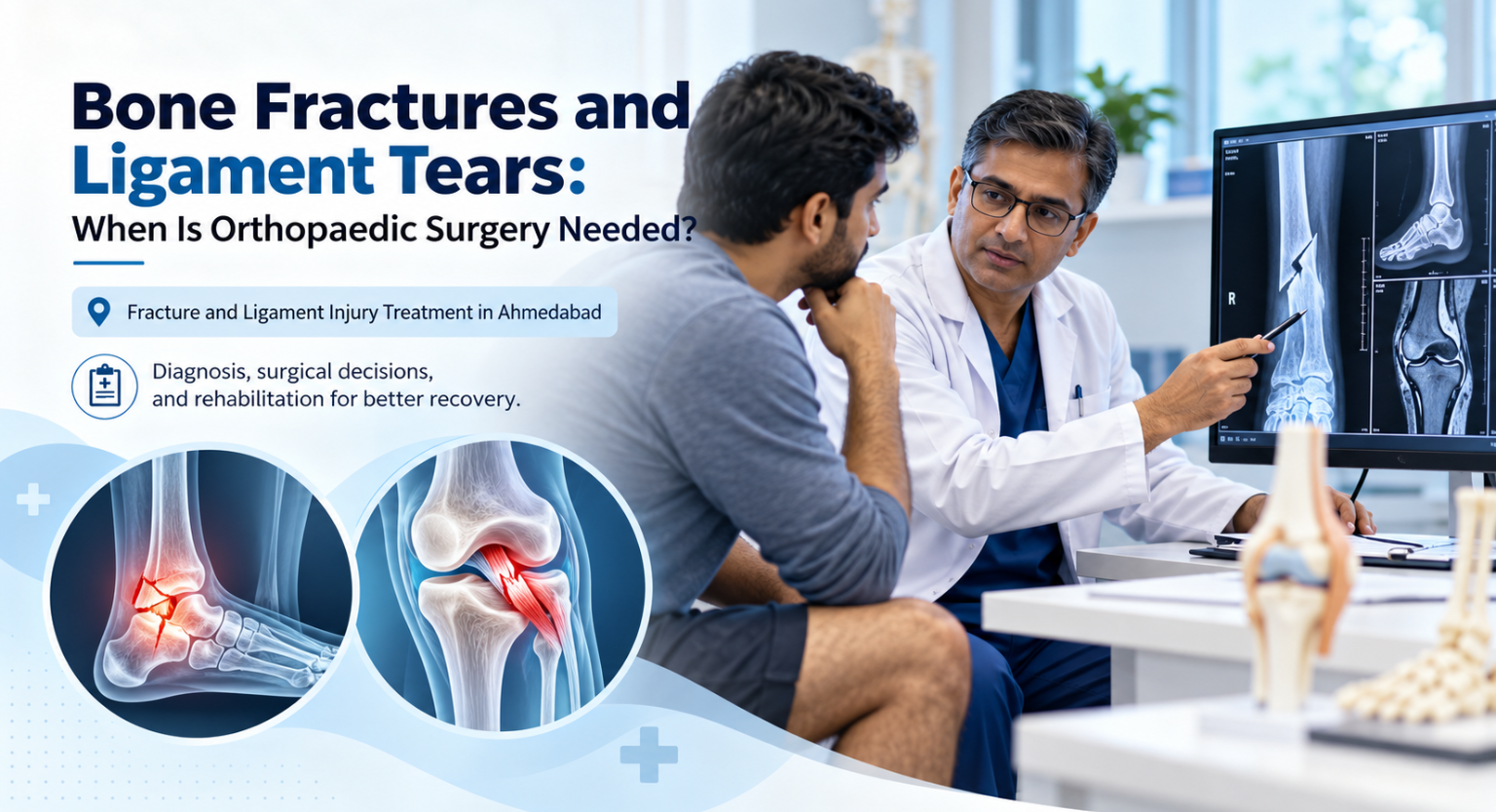
Fracture and Ligament Injury Treatment in Ahmedabad:
To explain the common types of fractures and ligament injuries, how they are diagnosed, when surgery may be required, and the role of rehabilitation in restoring movement and function.
Understanding Fractures and Ligament Injuries
Bones, joints, muscles and ligaments work together to support the body and enable movement. However, accidents, falls, sports activities, age-related bone weakness and sudden twisting movements can cause fractures and ligament injuries. Depending on the severity, these injuries may lead to pain, swelling, restricted movement and difficulty performing everyday activities.
Timely medical evaluation helps identify the extent of an injury and determine an appropriate treatment plan. While some fractures and ligament injuries can be managed without surgery, others may require surgical intervention and structured rehabilitation.
At Jivraj Healthcare, Ahmedabad, orthopaedic services include fracture management, surgical treatment for selected bone injuries, sports medicine and rehabilitation support.
What Is a Bone Fracture?
A bone fracture occurs when a bone develops a crack or breaks due to an impact, fall, accident or excessive force. Fractures can range from small cracks to complex breaks involving multiple bone fragments or nearby joints.
The treatment depends on the affected bone, fracture pattern, degree of displacement, surrounding tissue damage and the patient’s overall health.
Common types of fractures include:
- Simple fractures: The bone breaks without an open wound communicating with the fracture.
- Open fractures: The fracture is associated with a wound that exposes the bone or communicates with the fracture site.
- Comminuted fractures: The bone breaks into multiple pieces.
- Intra-articular fractures: The fracture extends into a joint surface.
- Long bone fractures: Breaks affecting bones such as the femur, tibia or humerus.
Some fractures require immediate medical attention, particularly when there is an open wound, visible deformity, severe pain, numbness or reduced blood circulation.
Common Symptoms of Fractures
Recognising the signs of a fracture can help patients seek appropriate medical care without unnecessary delay.
Common symptoms include:
- Persistent pain following an injury.
- Swelling or bruising around the affected area.
- Difficulty moving the injured limb or bearing weight.
- Tenderness when the area is touched.
- Visible deformity or an unusual limb position.
- Reduced movement or function.
Not every fracture causes obvious deformity. A person may still be able to move the affected limb despite having a fracture. Medical assessment and imaging, when indicated, are important for determining the nature of the injury.
Fracture Diagnosis and Treatment Options
Fracture treatment begins with an assessment of the injury, the patient’s symptoms and the condition of the surrounding tissues. The orthopaedic specialist may recommend X-rays or other imaging tests depending on the suspected fracture and its complexity.
Treatment options may include:
Non-Surgical Fracture Management
Some fractures can be treated with immobilisation using a cast, splint or brace. The aim is to keep the affected bone stable while healing takes place.
The treatment plan may also include pain management, follow-up imaging and guidance on weight-bearing or movement restrictions. Patients should follow their treating specialist’s instructions because the timing of movement and return to normal activities varies by fracture type.
Surgical Fracture Fixation
Fracture fixation surgery may be considered when a fracture is significantly displaced, unstable, involves a joint surface or cannot be adequately managed through non-surgical methods.
Depending on the injury, surgical techniques may include:
- Screw and plate fixation: Metal plates and screws are used to stabilise selected fractures.
- Closed nailing: A metal nail is inserted into the bone’s central canal, often to treat certain long bone fractures.
- Pinning: Pins are used to hold bone fragments in the required position.
- Bone grafting: Bone graft material may be used in selected cases where additional support for bone healing is needed.
Jivraj Healthcare’s published orthopaedic services include surgical management of long bone fractures using techniques such as screw-plate fixation, closed nailing, pinning and bone grafting, as well as intra-articular fracture fixation. The appropriate procedure depends on the individual injury and clinical assessment.
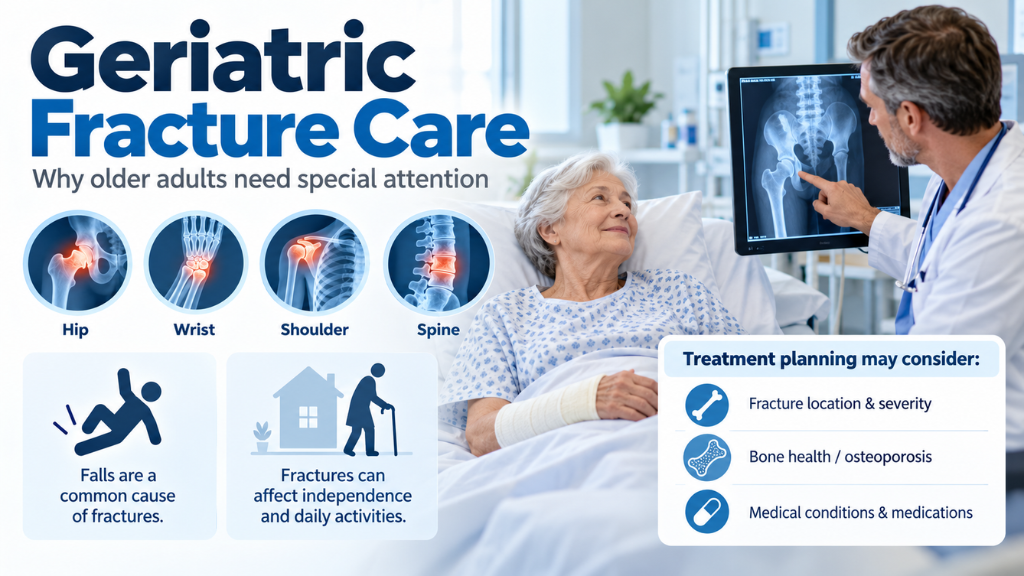
Geriatric Fracture Care: Why Older Adults Need Special Attention?
Fractures in older adults require careful evaluation because age-related changes in bone strength, balance, mobility and general health may affect treatment and recovery.
Falls are a common cause of fractures in older people. Injuries involving the hip, wrist, shoulder and spine can affect independence and make routine activities more difficult.
Treatment planning may consider:
- The location and severity of the fracture.
- Bone health and the possibility of osteoporosis.
- Existing medical conditions and current medications.
- The patient’s mobility before the injury.
- The need for surgery and the suitability of anaesthesia.
- Pain control, safe mobilisation and rehabilitation requirements.
When surgery is necessary, the goal is to stabilise the fracture and support recovery while considering the patient’s overall health. Depending on the injury, a combination of orthopaedic care, medical evaluation, fall-prevention measures and physiotherapy may be recommended.
Older adults should not assume that pain after a fall is simply part of ageing. Persistent hip pain, difficulty standing or an inability to bear weight after a fall warrants prompt medical evaluation.
What Are Ligament Injuries?
Ligaments are strong bands of connective tissue that connect bones and help stabilise joints. A ligament injury occurs when a ligament is stretched or torn, often because of sudden twisting, an awkward landing, direct impact or excessive joint movement.
Ligament injuries commonly affect the knee and ankle, although other joints can also be involved.
Examples include:
- Anterior cruciate ligament (ACL) injuries: Affect a major stabilising ligament in the knee.
- Medial collateral ligament (MCL) injuries: Involve a ligament on the inner side of the knee.
- Ankle ligament sprains: Often occur when the ankle twists unexpectedly.
- Shoulder ligament injuries: May occur following trauma or joint instability.
The severity can range from a mild stretch to a partial or complete tear. Symptoms may include pain, swelling, restricted movement and a feeling that the joint is unstable.
Ligament Injury Treatment: When Is Surgery Considered?
The treatment for a ligament tear depends on which ligament is affected, the extent of the injury, joint stability, activity requirements and whether other structures have been damaged.
Non-Surgical Treatment
Some ligament injuries improve with rest, appropriate protection, a brace when indicated and a progressive rehabilitation programme. Physiotherapy may help restore joint movement, muscle strength, balance and coordination.
Patients should avoid returning to sports or strenuous activity too early, as the injured joint may not yet be ready for the demands placed on it.
Testimonial
“I had a very good and satisfying experience at Jivraj Mehta Hospital. The doctors here are highly experienced and provide clear guidance with utmost care. The hospital environment is clean, well-organized, and efficiently managed by the administrative staff. The nursing team is extremely caring and attentive, ensuring patients feel comfortable throughout their stay. Overall, the patient care is excellent, and I truly appreciate the professionalism and compassion shown by the entire team. Highly recommended!“
Arthroscopic Reconstruction and Other Surgical Options
In selected cases, a severe ligament injury may require surgery. Arthroscopic surgery uses a small camera and specialised instruments inserted through small incisions to examine and treat certain joint conditions.
Ligament reconstruction may be considered for particular injuries, such as some ACL tears, especially when significant instability affects daily activities or sports participation. The decision depends on the clinical findings, associated injuries and individual goals.
Arthroscopy and ligament reconstruction are not necessary for every ligament tear. Patients should consult an orthopaedic specialist to understand the available options and whether a specific procedure is appropriate for their condition.
Before publishing specific service claims, Jivraj Healthcare should confirm the availability of dedicated arthroscopic ligament reconstruction procedures at the hospital.
The Role of Rehabilitation after Fracture or Ligament Treatment
Orthopaedic rehabilitation is an important part of recovery after many fractures and ligament injuries. Once the treating specialist determines that movement or exercise is appropriate, a structured programme may help restore function and reduce stiffness.
Rehabilitation may include:
- Gradual restoration of joint movement.
- Exercises to improve muscle strength.
- Balance and coordination training.
- Gait training and safe weight-bearing progression.
- Guidance on returning to work, daily activities or sports.
- Follow-up assessments to monitor functional progress.
The timing and intensity of rehabilitation vary. Starting certain movements too early may interfere with healing, while prolonged immobilisation can contribute to stiffness and muscle weakness. A personalised plan helps balance protection of the injury with the gradual restoration of movement.
Recovery time differs according to the injury, treatment method, age, general health and adherence to medical advice. No single recovery timeline applies to every patient.
Fracture and Ligament Care at Jivraj Healthcare, Ahmedabad
Jivraj Healthcare provides orthopaedic services for musculoskeletal conditions, including fracture management, selected fracture fixation procedures, sports medicine and physical or occupational therapy.
The hospital’s orthopaedic service information describes surgical options for long bone fractures and intra-articular fractures, along with post-surgical rehabilitation and follow-up care.
Patients experiencing a suspected fracture or persistent joint instability can seek an orthopaedic assessment to understand the nature of the injury and the appropriate next steps. Treatment recommendations are made according to the individual’s clinical condition rather than a single standard approach.
For details about available services, visit the Orthopaedics and Joint Replacement service page.
Orthopaedic Trauma Care in Ahmedabad
Fractures and ligament injuries can affect mobility, joint stability and everyday activities. Early assessment helps determine the extent of the injury and whether non-surgical treatment, fracture fixation or another intervention is appropriate.
For fracture treatment in Ahmedabad, understanding the available treatment options and following medical advice can help patients make informed decisions. Rehabilitation, follow-up care and a gradual return to normal activities are also important parts of the recovery process.
Frequently Asked Questions
What should I do if I suspect a bone fracture?
Avoid putting unnecessary weight on the injured area and seek medical attention. Do not attempt to straighten a visibly deformed limb. An open fracture, severe bleeding, numbness or a cold or pale limb requires urgent medical care.
Can a fracture heal without surgery?
Yes. Some fractures heal with a cast, splint or other immobilisation method. Surgery may be required when a fracture is unstable, significantly displaced, involves a joint surface or cannot be managed adequately without an operation.
When does a fracture require surgery?
The decision depends on the bone involved, fracture alignment, stability, joint involvement and surrounding tissue damage. An orthopaedic specialist uses clinical assessment and imaging to determine the appropriate treatment.
How are ligament injuries diagnosed?
Diagnosis generally involves reviewing the injury history, examining the joint and assessing its stability and movement. Imaging, such as an MRI, may be recommended when a significant tear or associated injury is suspected.
Does every ACL tear require reconstruction surgery?
No. Treatment depends on the severity of the tear, knee stability, associated injuries, activity requirements and individual circumstances. Some injuries can be managed with rehabilitation, while others may benefit from surgical reconstruction.
How long does recovery take after fracture or ligament surgery?
Recovery varies according to the injury, procedure, general health and rehabilitation plan. Patients should follow their treating specialist's guidance on movement, weight-bearing and returning to work or sports.
Why is physiotherapy important after orthopaedic treatment?
Physiotherapy can help restore movement, muscle strength, balance and functional ability when introduced at the appropriate stage. The programme should be tailored to the injury and the treating specialist's recommendations.