




Blog

Title Image

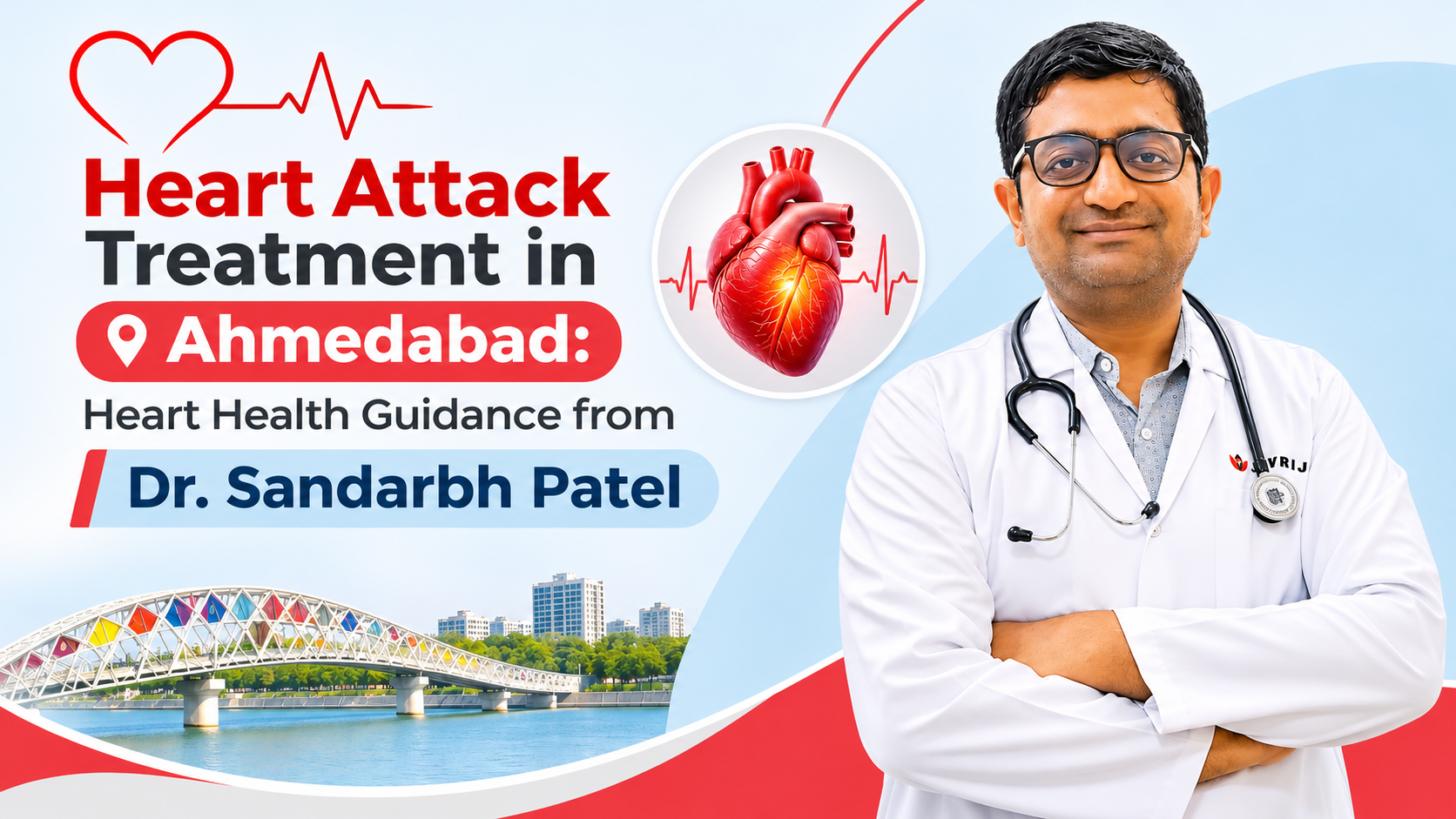
Heart Attack Treatment in Ahmedabad: Heart Health Guidance from Dr. Sandarbh Patel

Home  /  Blog   /  Heart Attack Treatment in Ahmedabad: Heart Health Guidance from Dr. Sandarbh Patel
Heart Attack Treatment in Ahmedabad at Dr. Jivraj Mehta Smarak Health Foundation under Guidence of Dr. Sandarbh Patel
Share At:
Google AI ChatGPT Grok Perplexity

Listen Article

To educate patients and families about the early warning signs of a heart attack, why heart problems are rising among young adults, and when tests such as an ECG, echo or angioplasty may be needed.

Many people believe that if they are not ill, they must be healthy. But not being ill and being truly healthy are not always the same thing, especially when it comes to the heart. In Episode 1 of Dr. Jivraj Mehta Hospital’s podcast series Navu Jivan… Navo Naato, “Tandurast Vaato”, cardiologist Dr. Sandarbh Patel speaks with host Kavi Ankit Trivedi about heart health in simple, everyday language.

The conversation covers why heart attacks are now being seen at a younger age, which warning signs should never be ignored, how angioplasty works, and what everyone can do to protect their heart.

Watch the Full Episode on YouTube

What Does an “Enlarged Heart” Mean?

In Gujarati, a generous person is often said to have a “big heart”. Medically, however, an enlarged heart can be a sign of a problem.

Dr. Sandarbh Patel explains that when he performs an echo (a sonography of the heart) on some patients for the first time, the heart’s pumping is around 20–25% instead of the normal 55–60%, and the heart is enlarged. Many of these patients say they had no problems until then. In reality, this does not happen suddenly. It develops over months or even years, but the early warning signs are often missed.

Quick Response Guaranteed
Contact Us!

Which Basic Heart Tests Should You Know About?

Whether a person comes with symptoms or without them, there are two basic tests used to assess heart health:

  • ECG (Electrocardiogram): Records the electrical activity of the heart on a page.
  • Echo (Echocardiography): A sonography of the heart, similar to an abdominal sonography. It shows how well the heart is pumping. Normal pumping is around 55–60%, and lower values are graded according to severity.

An echo is needed whenever a person has heart-related complaints. Dr. Sandarbh Patel adds that after the age of 30, doctors now also suggest an echo as part of a regular heart health check-up.

Why Are Heart Attacks Increasing in Young People?

According to Dr. Sandarbh Patel, heart attacks in young people account for around 5–18% of heart attacks worldwide. In India, this has risen to around 15–30% over the last decade.

Based on his observations, the main reasons include:

  • A sedentary lifestyle
  • Stress during school, college and the early years of a job
  • Obesity
  • Unhealthy food and eating habits
  • An increased tendency for blood clotting seen after the COVID-19 period

Earlier, a heart attack before the age of 50 was considered a “young heart attack”. Today, heart attacks are being seen in people below 40, and even below 30. Women, who earlier developed heart disease mostly around 45–50 years, are now being seen with it at 35–40 years.

Why Can a Heart Attack at a Young Age Be More Serious?

In older people, blockages usually develop slowly. Over time, the heart adapts, and small natural bypass channels may form, allowing blood to reach the heart muscle through other vessels.

In younger people, the fat build-up in the artery may be only 10–30%, but a blood clot can suddenly block the rest of the vessel. Because the heart has not had time to adapt, the sudden loss of blood supply can be harder for it to handle. In some cases, this can cause a dangerous heart rhythm, known as sudden cardiac death (SCD). This is why early recognition of symptoms is so important at a young age.

What Are the Warning Signs of a Heart Attack?

Dr. Sandarbh Patel explains that in around 80% of cases, the heart gives some warning before a heart attack, sometimes 2–3 days, a week or 15 days in advance. However, many people, especially young adults, believe “this pain cannot be from my heart” and ignore it.

Warning signs to watch for include:

  • A drop in your usual capacity, for example feeling breathless while climbing stairs you used to climb easily
  • Difficulty in breathing
  • Heaviness in the chest
  • Sweating
  • Uneasiness or restlessness
  • A fast heartbeat (palpitations)

Symptoms do not appear only during exertion. Pain or discomfort after meals can also be related to the heart. This is why heart patients are advised not to walk immediately after eating, and to wait 30–45 minutes.

Gastroenterology Services

Can Heart Pain Be Felt in the Back, Jaw or Throat?

Yes. Heart pain is not always felt in the chest. It can appear in the chest, the upper abdomen, the left shoulder, arm and fingers, the right shoulder, the jaw, the throat or the upper back. Women, more often than men, may feel symptoms such as a choking feeling in the throat, dryness or discomfort in the jaw.

Is It Gas or a Heart Problem?

One of the most common reasons for delay is assuming that chest discomfort is just gas or acidity. The symptoms of both can overlap. Sometimes chest pain turns out to be acidity, and sometimes what feels like acidity turns out to be a heart attack.

Dr. Sandarbh Patel shares that gastroenterologists are among the doctors who most often refer heart patients to him, because patients first visit them with “gas” complaints and an ECG then shows a heart problem.

His advice is simple: whether you are 20, 25 or 30, do not ignore chest pain. At the very least, see a nearby doctor and get an ECG done.

Call Now: +91-79-26636363 (24×7 Emergency Helpline)

WhatsApp Us: +91 63571 88191

What Is Angioplasty and When Is It Needed?

The heart is supplied with blood by three main arteries. When one of them has a critical blockage of 70%, 80% or 90%, angioplasty is the simplest and most widely available treatment.

In angioplasty:

  1. A thin tube is passed through an artery in the wrist or groin and guided up to the heart.
  2. Pictures of the heart’s arteries are taken (angiography).
  3. A wire is passed across the blockage, and a balloon is inflated to widen the narrowed part.
  4. A metal mesh tube called a stent is placed and expanded to keep the artery open, so that blood flow is restored.

Dr. Sandarbh Patel explains that the risk of the artery blocking again has come down considerably with modern drug-eluting (medicated) stents. Angiography and angioplasty can also be done using the same tube, in the same sitting.

How Quickly Does Angioplasty Need to Be Done?

There is no “right season” for heart treatment. The decision depends on how severe the blockage is:

  • A blockage of more than 70% usually needs a stent.
  • A blockage of more than 90–95% may need a stent without delay.
  • If a patient arrives during an ongoing heart attack, the decision often has to be taken within minutes.

What Advanced Angioplasty Techniques Are Available?

Angioplasty techniques have continued to evolve. Dr. Sandarbh Patel explains that at Dr. Jivraj Mehta Hospital, advanced techniques such as intravascular imaging are used. Just as doctors can look inside the stomach with a scope, a tiny imaging device can be passed inside a heart artery that is only 3–4 mm wide. This shows how much calcium, fat and fibrous tissue is present, and helps the team choose the right treatment approach.

When an artery has a lot of calcium, plaque modification techniques such as rotablation may be used. These approaches help plan angioplasty more precisely, including in complex cases.

Testimonial

“4th November finished full body check up from Health Department and it’s a very good experience. Supportive staff, Medical Professionals guidance and a medical infrastructure is best in class. I truly recommend healthcare services provided by Jivraj Hospital. Thank you JJ and its staff.“

Can a Heart Problem Be Managed with Medicines Alone?

Many patients prefer to “try medicines for a few days first”. Dr. Sandarbh Patel explains that there are two groups of patients:

  • Patients for whom medicines are suitable: If the ECG, echo and other tests are reassuring, doctors may advise a trial of medicines, and many patients do well on medicines for years.
  • Patients who need early treatment: When doctors advise early diagnosis and treatment, delaying it can be risky. Some patients who postpone treatment end up needing emergency care sooner than expected.

What Causes Heart Failure?

Thanks to growing awareness and better treatment, many heart attack patients now get timely care, which helps prevent the heart from becoming weak. However, when treatment for a heart attack is delayed, the heart’s pumping can weaken, and this can later lead to symptoms of heart failure. According to Dr. Sandarbh Patel, a missed or delayed heart attack is one of the most common causes of heart failure, in both younger and older people.

Heart Care at Dr. Jivraj Mehta Hospital

Dr. Jivraj Mehta Hospital is a trust hospital known for its human approach and compassionate care. As a trust hospital, it aims to keep treatment charges affordable so that patients do not face a heavy financial burden.

Dr. Sandarbh Patel explains that heart care at the hospital includes:

  • Diagnostic tests and imaging techniques for the heart
  • Angioplasty, including for complex cases
  • A heart failure clinic for patients whose heart has become weak, with regular follow-up and guidance on diet and fluid intake
  • Pacemaker implantation for patients with a slow heartbeat
  • Bypass surgery
  • An intensive care unit

Learn more about the hospital’s specialities and services.

Quick Response Guaranteed
Email Us Now!

How Can You Protect Your Heart?

Some things may be beyond our control, but taking care of our heart is in our hands. Dr. Sandarbh Patel recommends a few simple daily habits:

  • Stay active: Exercise for 30–40 minutes every day. If nothing else, go for a brisk walk.
  • Eat sensibly: Avoid oily, fatty, fast food and junk food. Choose a nutritious Gujarati diet of rotli, dal, rice, vegetables, fruits and salad.
  • Manage stress: Practise yoga and pranayama, and spend time with your family.
  • Control risk factors: Keep blood pressure, diabetes and cholesterol under control with proper treatment.
  • Get regular check-ups: Do not wait for symptoms to appear.
  • Do not ignore warning signs: Chest pain, uneasiness or breathlessness should always be checked.

Is It Worth Getting an ECG Even If It Turns Out Normal?

Yes. Dr. Sandarbh Patel puts it simply: if you get an ECG done ten times and it detects a heart problem even once, that one test makes all ten worthwhile. In heart conditions, catching a problem early can change, and even save, a life.

Call Now: +91-79-26636363 (24×7 Emergency Helpline)

Read Our Article: Cardiology Tips for Maintaining a Healthy Heart – Expert Advice at Dr. Jivraj Mehta Hospital, Ahmedabad

Our Other Specialities: jivrajhealthcare.org/services

WhatsApp Us: +91 63571 88191

Frequently Asked Questions About Kidney Stones and Prostate Problems

What are the early warning signs of a heart attack?

Common warning signs include breathlessness on exertion, chest heaviness, sweating, uneasiness, palpitations and a drop in your usual capacity. Pain may also be felt in the upper abdomen, arms, shoulders, jaw, throat or upper back.

Can young people have a heart attack?

Yes. Heart attacks are now being seen in people below 40, and even below 30. A sedentary lifestyle, stress, obesity and an unhealthy diet are among the main reasons.

How do I know if chest pain is gas or a heart problem?

The symptoms of acidity and heart problems can overlap, so it is not safe to assume. If you have chest pain, consult a doctor and get an ECG done.

When is angioplasty needed?

Angioplasty is usually advised when one of the heart’s main arteries has a significant blockage, generally above 70%, or during a heart attack. Your cardiologist will decide based on your tests.

At what age should I get a heart check-up?

Anyone with symptoms should get checked at any age. Even without symptoms, doctors now suggest including heart tests such as an echo in regular health check-ups after the age of 30.

<< 1 >>