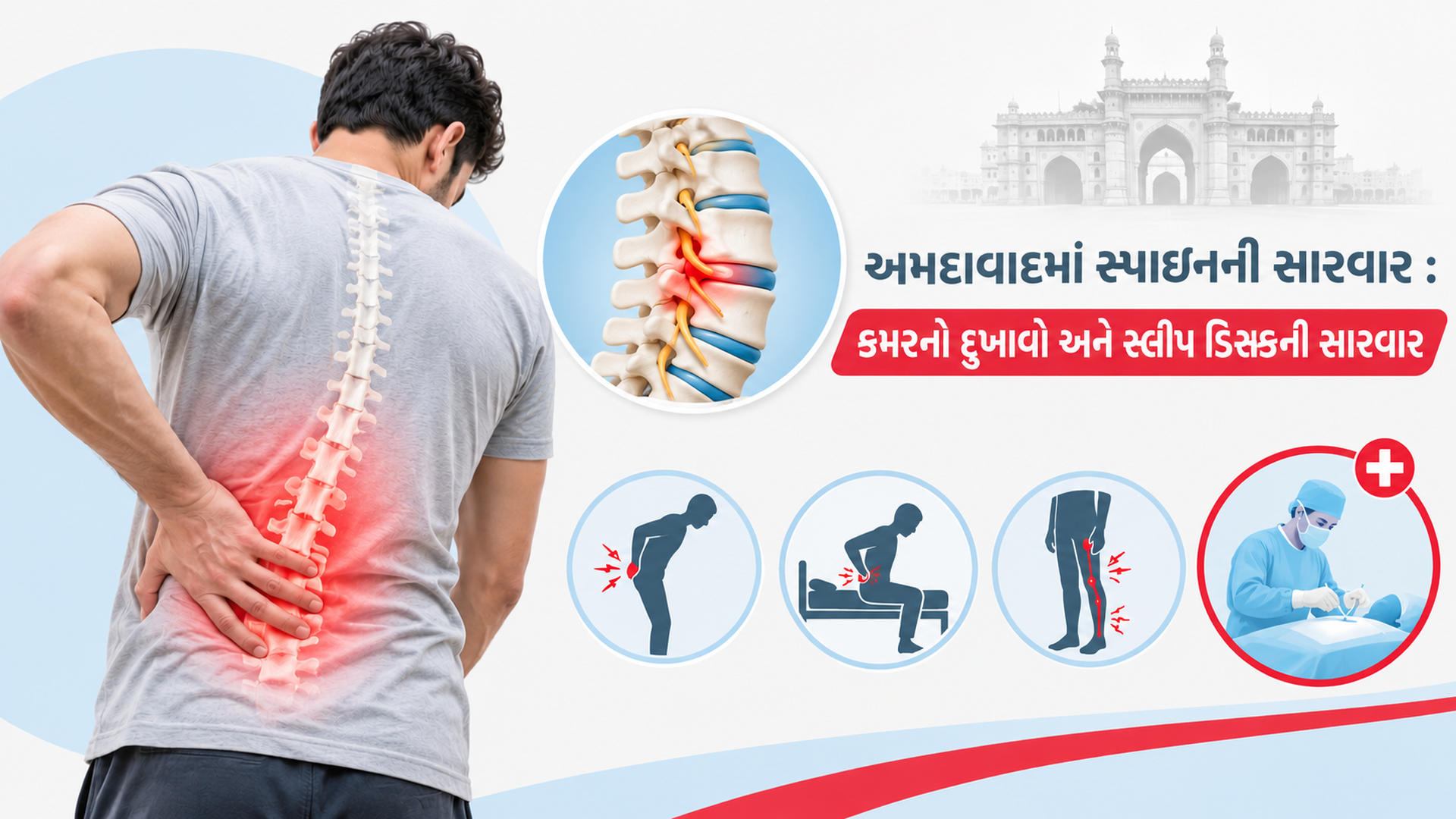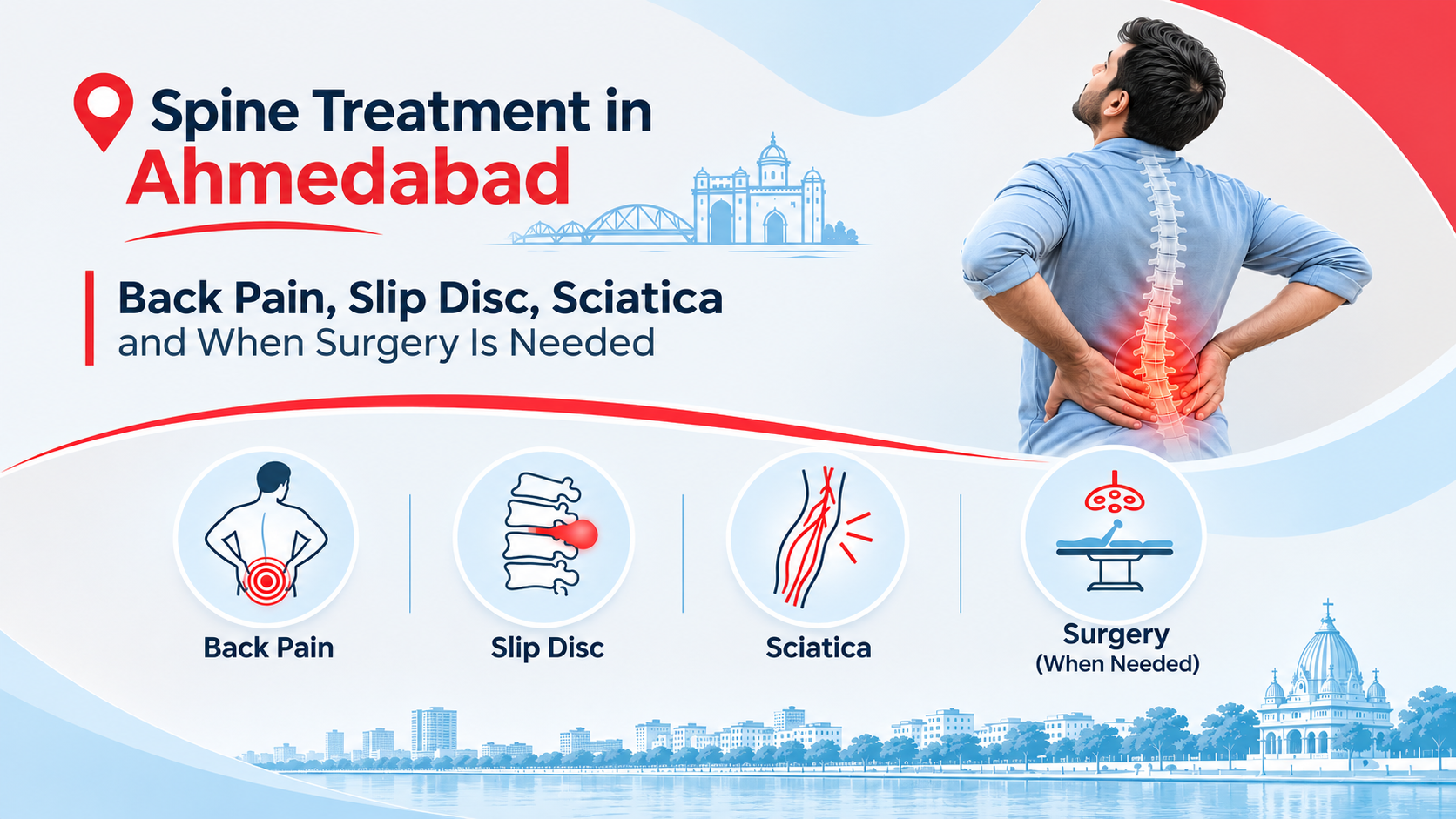
To educate patients about common spine problems such as back pain, neck pain, slip disc and sciatica, explain the warning signs that need prompt attention, clear common fears about spine surgery, and highlight the spine care services available at Jivraj Healthcare, Ahmedabad.
Back pain and neck pain are among the most common reasons people visit a doctor today, and they are no longer limited to older adults. Many patients delay treatment because of fear of surgery, myths heard from others or simply hoping the pain will settle on its own. This article is based on an episode of Navu Jivan Navo Naato, Tandurast Vaato, the health awareness podcast by Dr. Jivraj Mehta Hospital, in which writer and poet Ankit Trivedi spoke with Dr. Parth Sorathiya from the hospital’s Spine and Brain Department. It explains how the spine works, why spine problems are rising, which symptoms should never be ignored and how spine treatment in Ahmedabad is planned at the spine surgery department of Jivraj Healthcare.
What Is the Spine and How Does It Work?
The spine is the central support pillar of the body. As Dr. Parth Sorathiya explains, it is made of three basic parts:
Vertebrae: the bony blocks that give the body its main support
Discs: the cushions between the vertebrae that absorb shock and allow the spine to bend
Nerves: which travel from the brain through the spine to the arms, legs and other organs, controlling movement and sensation
Because every nerve that moves our hands and legs passes through the spine, a problem in one small area can cause pain, tingling or weakness far away from the back itself.
Why Are Spine Problems Becoming Common in Young People?
Dr. Parth Sorathiya observes that spine complaints are now very common among young adults, and lifestyle is the main reason. Work from home, online ordering and long hours in front of laptops and mobiles mean many people sit for most of the day and move very little. Sitting in a slouched or awkward position puts extra load on the spine. Junk food and obesity add further strain.
Even short breaks are often spent looking at a phone. Many young people develop rounded shoulders and neck strain from early years. For them, Dr. Parth Sorathiya advises controlling screen time, keeping a disciplined routine for waking and sleeping, and paying attention to posture. He notes that a large number of patients in the spine OPD have pain mainly because of poor posture, and many improve with posture correction alone.
What Is a Slip Disc and How Is It Related to Sciatica?
A slip disc happens when the cushion between two vertebrae moves out of its normal place and presses on a nearby nerve. Slip disc, sciatica and nerve compression are closely related terms for this same problem. Common symptoms include:
- Pain that travels from the back into the leg, or from the neck into the arm
- A current like sensation, tingling or numbness in the leg or arm
- Pain so severe that sitting becomes difficult
Long hours of continuous sitting are a frequent trigger. Dr. Parth Sorathiya gives the example of musicians who play the keyboard for two to three hours at a stretch, sometimes in more than one programme a day. A sudden jolt over a bump while driving, or lifting heavy weights in the gym with a bent back and without a trainer’s guidance, can also bring on a slip disc.
Our Other Specialties
Neurology TreatmentHow Can You Protect Your Spine at Work, on the Road and at the Gym?
- Desk work: take a short break every 40 to 45 minutes. Stand up, stretch, walk for about five minutes or combine the break with a tea break or a small task.
- Long drives: stop for a break every two to two and a half hours, and slow down on potholes and rough roads.
- Gym: learn correct technique from a trainer before lifting weights, and never lift with a rounded back just to keep up with what you see on social media.
- At home: Dr. Parth Sorathiya advises most spine patients to avoid three things as far as possible: sitting on the floor, bending forward and lifting heavy objects.
- Lifting the right way: if your work requires lifting, bend your knees, keep your back straight and hold the object close to your body so the load on the spine stays low.
Which Spine Symptoms Are Red Flags?
Most back pain settles with simple care, but some symptoms are red flags that should not be ignored. See a spine specialist promptly if you notice:
- Severe leg pain or current like pain that does not improve with any treatment
- Numbness in the soles, as if you are walking on cotton
- Weakness in the leg, such as slippers slipping off while walking
- Foot drop, where the foot cannot be lifted up and down normally
- Loss of control over urine or stools, which needs urgent medical attention
Repeated numbness or constant leg pain is also a signal to get checked rather than to keep waiting.
Why Is an MRI Important for Spine Problems?
Many people feel anxious when a doctor suggests an MRI. Dr. Parth Sorathiya explains that an MRI is simply a detailed picture taken using magnets instead of X rays. Its advantage is that it shows nerves and soft tissue clearly. In spine problems, the key question is how much a nerve is being pressed, and the MRI helps answer it.
This information guides the treatment plan. It helps the specialist decide whether a patient is likely to improve with medicines, what precautions are needed, or whether the pain is likely to keep returning unless the pressure on the nerve is relieved with a procedure.
How Are Back Pain and Slip Disc Treated?
Most spine patients improve with medicines and a period of reduced activity. Only a smaller group needs injections or surgery. Dr. Parth Sorathiya outlines the usual steps:
- Medicines and relative rest: complete bed rest is not needed for most spine pain. If pain is very severe, rest for about 24 hours and then start moving gently.
- Physiotherapy: when medicines alone do not give enough relief, physiotherapy such as electrotherapy and diathermy may be added.
- Back strengthening exercises: once the acute pain settles, exercises to strengthen the back muscles help prevent the pain from returning.
- Posture and lifestyle changes: correcting daily habits reduces the chance of repeated episodes.
- Surgery: advised when red flag symptoms appear or the MRI shows significant nerve compression. It may be done as open surgery or as minimally invasive surgery.
Is Spine Surgery Safe? Clearing Common Fears
Many people fear spine surgery because of stories that it often fails. Dr. Parth Sorathiya points out that such stories usually come secondhand, often from people who never had the surgery themselves, and that instruments and techniques have improved greatly over the last 20 to 30 years.
During surgery the patient is under anaesthesia and feels nothing. In minimally invasive spine surgery, the surgeon works through small openings instead of a large incision, and many patients are able to walk soon after the procedure. When a disc is pressing on a nerve, removing that pressure often eases leg or arm pain quickly, although recovery differs from person to person.
For example, when a disc in the neck presses on a nerve and causes arm pain, tingling and weakness, surgery may be advised without delay. In suitable cases the disc portion pressing on the nerve can be removed through a small incision of about 3 cm at the front of the neck. The treating team explains the benefits, possible risks and recovery plan before any decision.
Why Delaying Treatment for Nerve Compression Can Affect Recovery
Dr. Parth Sorathiya uses a simple example. If your finger gets caught in a drawer and you open it at once, the finger recovers. If the finger stays pressed for years, even the most skilled doctor cannot fully undo the damage. A nerve behaves the same way. Surgery removes the pressure, but how much strength and sensation returns depends on how healthy the nerve still is.
This is also true for older adults. Degenerative spine problems are more common with age, and spine surgery is often performed in elderly patients. Many people keep postponing treatment with painkillers, even after being advised surgery, until long standing pressure in the neck begins to affect the arms or legs. Timely assessment gives the nerve a better chance to recover and helps older adults stay active and independent.
Our Other Specialties
Physiotherapy & RehabilitationCan Vitamin B12 or D3 Deficiency Cause Tingling and Numbness?
Yes. Vitamin B12 comes mainly from animal foods, so many vegetarians, including those who avoid eggs, develop a deficiency with age. Vitamin D3 is produced in the body with the help of sunlight, and indoor lifestyles mean many people do not get enough. Dr. Parth Sorathiya compares these vitamins to engine oil in a car: even with fuel in the tank, the engine runs poorly without good oil. A deficiency can leave a person feeling tired, low on energy and unable to sleep well. He suggests spending around half an hour in the gentle morning sun, and a blood test can show whether supplements are needed.
B12 is important for nerve health, so a deficiency can cause tingling and numbness. A useful clue is the pattern. Vitamin deficiency usually affects both hands or both feet in a similar way. A slip disc usually presses on the nerve on one side, so symptoms are stronger in one leg or one arm. This difference helps the doctor decide which tests are needed.
Brain and Nerve Symptoms That Need Medical Attention
The Spine and Brain Department also evaluates neurological problems. Persistent or unusual headaches, dizziness, numbness, weakness in an arm or leg, or difficulty with balance should be assessed by a doctor. Sudden weakness on one side of the body, slurred speech or a sudden severe headache needs emergency care.
Everyday Habits for a Healthy Spine
- Use the mobile with purpose: cut down time on apps that add nothing to your day. Dr. Parth Sorathiya suggests keeping the phone outside the bedroom at night unless your work needs you on call.
- Avoid working in bed: using a laptop propped on pillows is a common cause of morning back and neck pain.
- Keep your back and neck straight while sitting, standing and using screens.
- Maintain a healthy weight and pay attention to diet.
- Exercise regularly: an early morning walk or cycling helps more than tracking what others are doing on fitness apps.
- Personalise your routine: every body is different, so follow advice suited to your weight, fitness and condition rather than a generic app target.
Spine Care at Jivraj Healthcare, Ahmedabad
Patients looking for spine surgery in Ahmedabad or non surgical care for back and neck pain can consult the spine surgery department at Jivraj Healthcare. Care includes evaluation with imaging such as MRI and CT scan, pain management, physiotherapy and rehabilitation, and surgical options including traditional and minimally invasive spine surgery for conditions such as slip disc, spinal stenosis and degenerative disc disease.
The treatment plan is decided after assessment, and surgery is advised only when it is needed. Appointments with Dr. Parth Sorathiya can be booked through the OPD appointments page.
Taking Care of Your Spine Before Problems Grow
Computers, televisions and mobiles are part of daily life at every age, and many people know exactly which habit is behind their back pain, often one linked to their work. The goal is not to give these up but to use them wisely, take regular breaks, keep a good posture and stay active. If symptoms move beyond the back into a limb, an early consultation can prevent a small problem from becoming a long one.
Jivraj Healthcare in Ahmedabad offers diagnosis, non surgical treatment, spine surgery and rehabilitation under one roof, so patients can be guided from the first consultation through to recovery.
Frequently Asked Questions About Spine Treatment
Is walking good for back pain?
For most people, yes. Gentle walking keeps the spine moving and helps recovery. Complete bed rest is rarely needed. If walking sharply increases leg pain, numbness or weakness, consult a spine specialist.
Does every back pain need an MRI?
No. Most short term back pain without red flag symptoms does not need an MRI at first. The doctor usually recommends one when pain spreads to the arm or leg, does not improve with treatment, or comes with numbness or weakness.
Can a slip disc heal without surgery?
Many can. In a large number of patients the disc related pain settles over a few weeks with medicines, activity changes and physiotherapy. Surgery is considered when there is significant nerve compression or red flag symptoms.
Which mattress is better for back pain?
A medium firm mattress that supports the natural curve of the spine suits most people. A very soft mattress that sags can strain the back.
Can I exercise after a slip disc?
Yes, once the acute pain settles and with guidance. A physiotherapist can plan stretching and back strengthening exercises suited to your condition. Avoid heavy lifting until your doctor advises.
Is spine surgery possible for elderly patients?
Age alone is not a barrier. The decision depends on the patient's overall health and fitness for anaesthesia, which the team checks before surgery.
How soon can I return to work after minimally invasive spine surgery?
It varies with the procedure and the type of work. People with desk jobs often return sooner than those whose work involves lifting. Your surgeon will guide you based on your recovery.
Where can I consult a spine specialist in Ahmedabad?
You can call Jivraj Healthcare on +91 79 2663 6363 or send a WhatsApp message to +91 63571 88191 to book an appointment with the spine department.